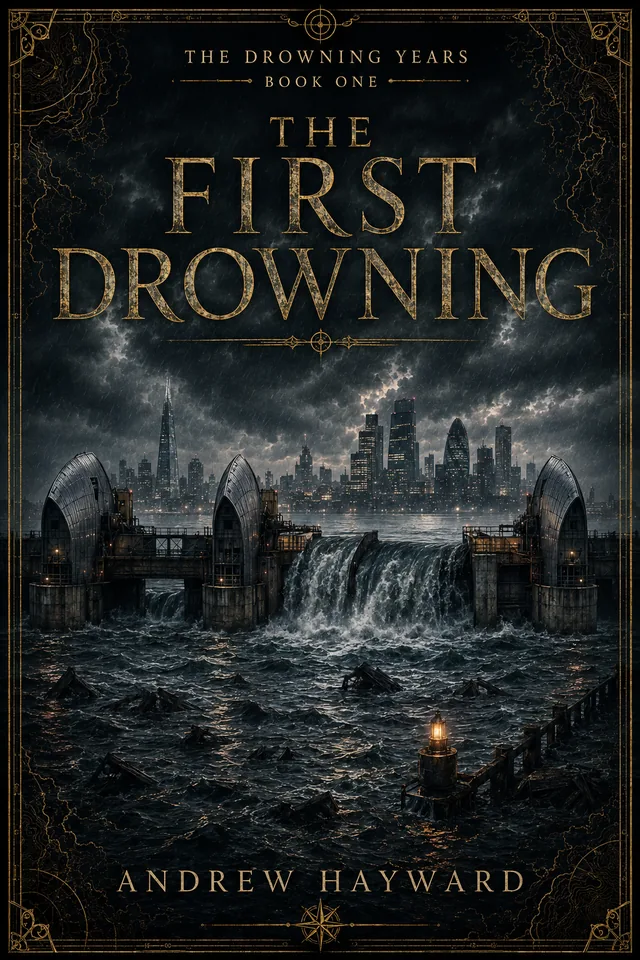
THE DROWNING YEARS · BOOK ONE
The First Drowning
An extract — about 9 minutes
Prologue — The Line on the Wall
Rotterdam had painted the line in red.
Not warning red. Not the theatrical red used on evacuation posters or emergency locks or the backs of warning doors where citizens were meant to understand danger quickly and without argument. This was a working red. Faded, scratched, half-covered by grease where men and women had leaned against the concrete during long shifts and forgotten that the line had once made them afraid.
It ran across the north wall of Control Room Three, just below the old analogue tide clocks, a handspan above the shelf where spare sensor batteries were kept in labelled crates.
MAXIMUM HISTORICAL SURGE LEVEL, 2079. Someone, years ago, had written beneath it in black marker:
never again.
Someone else had crossed that out after the inquiry into the 2088 season and written:
not yet.
Nathan Keir had always disliked both additions. Engineers had no business making promises to water.
He stood beneath the clocks with one hand around a paper cup of coffee that had gone cold before he remembered to drink it. The control room hummed around him: screens, relays, low voices, pumps, the steady mechanical pulse of the barrier system answering the North Sea. Rain hammered the upper glass hard enough to turn the night outside into a grey sheet. Every few seconds the whole building gave a deep-boned shudder as another pressure wave rolled through the outer gate field.
The clocks kept their calm.
Amsterdam.
London.
Oslo.
Copenhagen.
Rotterdam local.
North Sea reference.
The last one was not a city, but they had given it a clock anyway. Nathan had always liked that. It admitted something most public briefings avoided. The sea had its own time.
“Outer western gate is six seconds behind tolerance.”
Pieter van Dalen said it without looking up from his station.
Nathan crossed the room.
“How many cycles?”
“Three.”
“Sensor lag?”
“That is what I would prefer it to be.”
Nathan leaned over the display. Rainwater streaked the reinforced glass beyond the room, making the floodlights outside smear and bend. On the screen, the outer western gate pulsed amber against the modelled field. Not red. Not yet. Amber meant attention, not failure. Amber meant someone would be asked later why it had not been handled before red became necessary.
“Hydraulic response?” Nathan asked.
“Within stated tolerance.”
“Actual tolerance or budget tolerance?”
Pieter gave him a tired look.
That was answer enough.
The Rotterdam North Sea Barrier Complex had been praised in thirty-two languages and filmed by every documentary crew that liked officials in hard hats. It was not one wall. It was a chain of gates, pressure locks, relief basins, spill fields and old municipal drainage systems bullied into acting as one organism.
Most days, Nathan admired it. Tonight he did not.
Tonight it felt less like an organism than a patient being made to stand for another photograph.
“Where’s maintenance on W-seven?” Nathan asked.
“Deferred.”
“When?”
“Six months.”
Nathan looked at him. Pieter kept his eyes on the display. “Three months formally. Six in practice.”
“Because?”
“Because the eastern section had visible fatigue. Because the Belgian delegation visit required clean external access. Because the October budget revision did what October budget revisions do.”
The room shook again. This time the spare batteries on the shelf clicked against one another.
A woman at the comms desk glanced up at the red line on the wall.
Nathan saw her do it. So did Pieter.
The surge model refreshed. For half a second the control room turned blue-white with projected water.
North Sea pressure: above forecast.
Wind shear: above forecast.
River outflow: delayed.
Outer wave train: irregular.
Secondary pulse: forming.
The model did not show fear. It showed numbers in well-behaved columns.
That was one of the dangers of models. They had excellent manners.
“Control Three to Western Gate Field,” Nathan said, touching his headset. “Confirm local reading on W-seven lag.”
Static breathed in his ear. Then a voice came through, flattened by weather.
“Western Field to Control Three. Confirm lag. We’re getting vibration through the lower arm. Not severe.”
“Define not severe.”
A pause.
Nathan hated pauses in engineering reports.
“Not severe enough to stop movement.”
Pieter muttered something in Dutch under his breath. Nathan ignored the words and understood the meaning.
“Any visible deformation?”
“Negative. Rain’s too heavy for clean visual.”
“Use thermal.”
“Thermal’s patchy.”
“Then use someone’s eyes.”
Another pause.
“Copy.”
Across the room, a public liaison officer was speaking into a separate line in the soft, trained tone used when the public needed to be reassured without being fully informed.
“No change to civic advisory level at this stage. Repeat, no change. The barrier is operating within expected storm conditions.”
Nathan turned.
“Who authorised that phrasing?”
The liaison officer covered the receiver. “National Resilience feed.”
“It’s not within expected storm conditions.”
“It’s within public advisory range.”
“That is not the same sentence.”
“No,” she said, and there was no defensiveness in her voice. Only fatigue. “But it is the sentence I have.”
Pieter looked at Nathan then, briefly.
There it was again. Not corruption. Not incompetence. The people in this room were competent. They measured, revised and absorbed new data every minute.
The danger was softer.
Language had begun putting cushions around hard facts. A compromised gate became a delayed component. A failed threshold became a revised tolerance. A wall under strain became infrastructure performing under challenge.
No single phrase was a lie on its own. Together, they formed a room in which truth arrived late.
The surge model refreshed again. This time the amber gate flashed red. No alarm sounded at first. For one absurd second, the room seemed embarrassed.
Then Control Three filled with noise.
“W-seven response outside tolerance.”
“Outer western vibration increasing.”
“Pump corridor two showing back pressure.”
“Relief basin north approaching capacity.”
“Secondary pulse confirmed.”
Nathan set down his coffee. It tipped slightly, spilled cold brown liquid across the edge of the console, and no one noticed.
“Lock sequence?” he asked.
“Running.”
“Manual override ready?”
“Ready.”
“Run it.”
Pieter’s hands moved across the controls.
On the main screen, the western gate cluster adjusted. Slowly. Too slowly. It was meant to meet the incoming pressure at a controlled angle, neither resisting fully nor yielding too soon. That was the genius of the system. It did not pretend water could be stopped absolutely. It negotiated.
Tonight, the negotiation was late.
“Come on,” Pieter said.
The gate moved another degree. The room shook hard. A clipboard fell from the edge of a desk. Someone swore. The liaison officer stopped speaking.
On the wall, beneath the tide clocks, water had begun to weep through a hairline crack in the concrete.
Not floodwater. Condensation, perhaps. Driven rain forced through an old service seam. Some harmless internal failure with an explanation that would satisfy a maintenance report.
Still, it ran downward across the painted red line.
Nathan watched it cross the words MAXIMUM HISTORICAL SURGE LEVEL, 2079. Pieter saw his face and turned.
“Oh,” he said.
It was a small word. Almost tender.
The main screen showed the western gate cluster catching at last. The system groaned, corrected, redistributed load. Pump corridor two surged. Relief basin north overtopped its first lip and poured into the secondary field exactly as designed.
For thirty seconds, the barrier saved the city.
Nathan would remember that later, when newspapers called it a failure. He would remember the crews outside in murderous rain, Pieter’s hands steady on the controls, and the pumps taking more punishment than their designers had promised. The system had done the impossible for half a minute because people had built it well and cared for it as best they could.
Then W-seven stalled.
Not fully open.
Not fully sealed.
Caught between obedience and surrender.
The incoming secondary pulse struck the gate at an angle the public model had not retained, though an older internal model had. Nathan had seen it nine months earlier in a stress review and marked it for escalation.
The review note had come back amended.
Low probability compound scenario.
No public action required.
Monitor under future funding cycle.
The lower arm buckled.
The sound arrived through the building before the data did: a long, metallic cry, so deep it seemed to come from beneath the floor rather than outside. The room flinched as one body.
Then the alarms became honest. Red spread across the western gate field.
“Structural compromise.”
“Backflow through W-seven.”
“Secondary basin breach.”
“Western spill corridor active.”
“City district alerts?”
“Pending national authorisation.”
Nathan turned so sharply that his headset cable caught against his collar.
“Pending?”
The comms officer’s face was pale. “We have advisory escalation ready. National has not cleared full civic alarm.”
“Sound it.”
“I don’t have authority.”
Nathan crossed the room.
“Nathan,” Pieter said.
“Sound it.”
The comms officer looked at him, then at the escalation panel beneath its transparent guard.
“You’ll end your career.”
Nathan almost laughed. Not because it was funny, but because for one mad second the words seemed to belong to another species. Career. In a room where a wall had begun to cry and a gate was failing by degrees and the North Sea was writing its own report in steel.
He lifted the guard himself.
“Nathan,” Pieter said again, quieter this time.
Nathan looked back.
Pieter did not shake his head. He did not warn him off. He only looked, in that grave Dutch way of his, as if he were already remembering the moment for an inquiry.
Nathan pressed the alarm. Across Rotterdam’s low districts, sirens began to speak.
Not the advisory tone.
Not the soft civic chime used for controlled evacuation drills.
The real siren. The old one. The one that had survived three policy reviews because no committee had been brave enough to remove it.
Control Three went still around him. Then everything moved at once.
The public liaison officer began shouting into her line. The comms desk lit up. External crews called in over one another. Gate data cascaded down the main screen. Somewhere beyond the reinforced glass, through rain and night and floodlight glare, the western field spilled water into places the city had been told would remain dry.
Nathan stood beneath the red line and felt, for the first time in his life, not that the sea was stronger than human beings.
He had always known that. What he felt was worse. He felt that the sea had arrived on time, and truth had not.
By dawn, parts of Rotterdam would be under emergency water. By the end of the week, the inquiry would begin its polite work.
By the end of the month, Nathan Keir’s name would be attached to unauthorised alarm escalation, procedural breach and public disorder amplification. He would be praised privately by some, blamed publicly by others, and quietly removed from any post where his judgement might again embarrass language before policy had approved it.
Years later, in London, someone would ask him why he no longer trusted reassurance. Nathan would think of this room.
The clocks.
The rain.
Pieter’s hands.
The gate holding for thirty seconds.
The red line on the wall.
And the thin run of water crossing it before anyone was ready to say what it meant.
The First Drowning is Book One of The Drowning Years. Paperback and Kindle editions are coming soon.
Read another: The Returned Sky · The Seven of the Gyre · The Drownborn