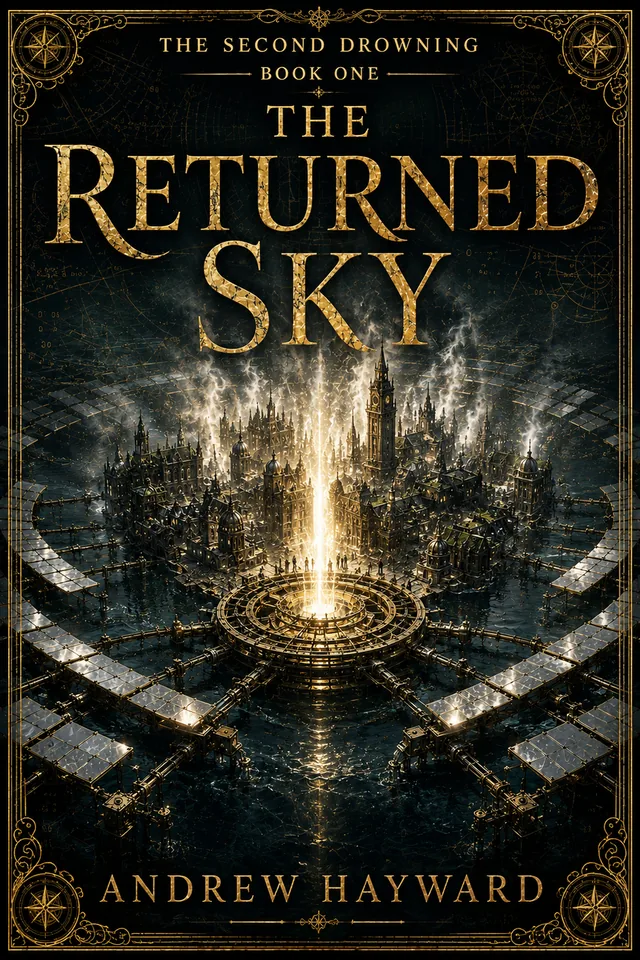
THE SECOND DROWNING · BOOK ONE
The Returned Sky
An extract — about 11 minutes
Prologue — The Oldest Array
They came up on the array in the last of the light, the way the family had always done it, because the evening water was the quiet water and the quiet water was when an array could be heard thinking.
The tender was called Provenance. The name was not the family’s joke but the convoy’s, made so long ago that nobody laughed at it or was meant to. Bren Crane brought her to station off the first marker buoy and let the way come off her, and his daughter took the wheel without being asked, and his son went forward to the winch without being asked, and for a while the only sounds were water against the hull and the small ringing of shackles being laid out in the order they would be wanted.
The array hung below them in four hundred fathoms of listening. It was the oldest in the convoy’s keeping and among the oldest anywhere, a founding-era instrument whose lowest head had been set in the first years of the pressure roads by hands that were now names. Those names were spoken twice a year over this water. The Cranes had kept the array for four generations: every generation there had been.
Bren Crane checked his line himself. He always did. Then he handed it to his children and they checked it again, because that was the order of the work: the diver trusts the line, the line trusts the keepers, and nobody is insulted. Thea ran the line through her hands from thimble to bitter end with her eyes closed. She was twenty-three and had done this since her hands were big enough to close around it. Ansel checked the lamp, the spare lamp and the tool sling. He re-hung the sling so the third spanner rode where the second had been. Their father looked at the change, tested it against the reach of his own arm, nodded, and left it that way.
While the light lasted, Bren dressed the spare seal at the transom bench, and his children watched because watching was the second half of every task the family owned. He worked the leather in tallow warmed against the lamp glass, seated it dry in the practice ring, and drew it out again, and passed the ring to Thea, who ran her thumbnail once around the seat and passed it to Ansel, who did the same. There was a torque that the pattern called for and a torque that the coupling wanted, and they were not the same number, and the difference was not written anywhere. It lived in the forearms of keepers, four generations of it, and it went into the sling with the dressed seal, invisible, the heaviest tool they carried.
“To the pattern,” Bren said, in the voice of a man quoting, and his daughter looked up at the tone, and he was already turning to the line.
“Seal again,” Bren said. It was not a question and nobody answered it. The winter head’s riser carried a coupling at the second stage, and the coupling carried a seal, and the seal was the founders’ pattern, cut and seated the way the first keepers had cut and seated it, and it wept. It had wept the season before, and the season before that, and each time it was drawn, dressed, and re-seated to the pattern, and each time it held a little less of the year than the time before. The pattern was one hundred and nineteen years old. There were newer patterns. That was all that was ever said about it, in exactly those words — there are newer patterns — and the words were always allowed to finish the conversation rather than begin one.
He went down the line with the last light going. Thea kept the line. Ansel kept the time and the lamp-watch, and logged the descent in the array’s book — the same book, in its eleventh volume, that the first Crane had opened when the roads were new. The entries above his entry ran back up the page in his father’s hand and then in his grandmother’s hand, and the hands were different and the entries were the same, because the work was the same. Descent on the winter riser. Second-stage coupling. Seal drawn and dressed.
The line talked. That was how the family said it: the line talks, learn its voice, and never let anyone tell you it is only rope. Two pulls, resting. One long draw, paying out. The small irregular tremor that was a man working with both hands while the sea held him. Thea stood with the line riding light on her palm, taking its weight without weighting it, and called the depth marks quietly as they went over the fairlead, and Ansel wrote them down. Past the first markers. Past the second. A pause at the second stage, two pulls: resting. Then one pull and a tremble held long, the sign for working the coupling, and Thea answered it with a single soft pull that meant line ready, and the answer went down four hundred feet of wet hemp the way a word goes down a corridor of a house where everyone has lived a long time. On the riser now. The tremor of work.
Ansel trimmed the lamp. The convoy’s lights were coming on behind him and he logged those too, in the margin, because his grandmother’s entries had margins like that — supper lamps, first stars, a dog barking on the water. He had grown up treating those margins as part of the reading. No one in the family thought otherwise.
The evening went on being an ordinary evening. That is the thing about such evenings, and the book of the array recorded hundreds of them, and this was another: a tender at station, a line down, a lamp lit against the dusk, two young keepers doing the surface end of an old procedure while the sea turned the colour of the inside of a shell. In the convoy, half a mile off, the supper lamps were being lit in an order as fixed as the stars, and a dog was barking on the water in the way that carries.
The line stopped talking.
Not slack. Slack has its own voice and Thea knew it, and this was not it. The line simply went still, the way a mouth goes still, and then it took up a weight that was wrong — not the swinging deadweight of fouled gear, and not a diver resting, but a steady taken-up heaviness with no work in it, as if the sea had closed its hand around what it held and was now simply holding it.
“Time,” Thea said.
“Nineteen minutes,” Ansel said.
She gave the line the recall. Three pulls, spaced, the oldest sentence in the family’s grammar. The line did not answer. She gave it again. Her hands did everything they had been taught; her voice stayed level. Ansel was already at the winch with the pawl freed. Neither of them said anything that was not procedure.
They brought him up together, taking turns at the crank, keeping the rate, because you keep the rate even then — especially then — and the darkness finished arriving while they worked, so that the last of it was done by lamplight, the line rising out of a black circle of sea, and the water coming off it in drops that flashed as they fell.
The seal had let go while the coupling was drawn. The array would say that much afterwards to anyone who could read it: a brief pressure voice on the deep head’s trace at nineteen minutes, a signature the instrument had faithfully kept because keeping was what it did. The founders’ pattern had wept its last of the year all at once, into the housing, with a man’s hands inside it.
What the children did was correct. The convoy said so afterwards, and the convoy did not say such things lightly, and the entry in the book — recovery effected, rate kept — is in Ansel’s hand, and the hand does not waver, and that also was correct, because the log is the log.
The Provenance came back through the supper lamps with her ensign at the crosstrees, and the convoy took the word from the ensign before the tender was within hail, in the way of people who have lived their whole lives reading small signs on the water, and by the time the line was made fast there were hands on the rail waiting, and nobody asked the children anything, and someone had already gone for the listener.
On the second day the listener came aboard the Provenance and drew the deep head’s trace for the hour of the dive, and read it at the chart table with the children standing by, because the family were the keepers and the keepers stand by. The trace ran clean and quiet up to the nineteenth minute. At the nineteenth minute there was a mark like a small dark feather, and after it the trace ran clean and quiet again, and that was all. The listener laid her finger beside the feather without touching the paper. She said the array had heard it, and had kept it, and would keep it now in its record for as long as the record was kept, with the winters and the crossings and everything else it had ever heard; and she said this as if it were a comfort, and to her it was one, and the children stood by, and the trace said what it said.
They buried Bren Crane in the way of the roads, which is to say the sea kept him and the convoy kept his name. That was on the third day. On the fourth day they blessed the array.
It was done at evening, on the quiet water, from three boats rafted together over the heads, the whole convoy standing off in a ring of riding lights. The listener was an old woman named for a grandmother of her own. She spoke the array’s provenance entire, as she did twice a year, only now with one name more at the end. She named the founders who had set the lowest head when the roads were new; the keepers in their generations, hand to hand; the vessels that had served it; the winters it had heard; the crossings it had brought home safe. Those crossings were counted not in numbers but in names. The names went on for a long time. The convoy stood and heard them. The water was very still.
Then she said that the array was of the first pattern, and the first pattern was the founders’ teaching set in metal, and what the founders set was not theirs to unmake, and the coupling would be made good to the pattern, as it had always been made good, by the hands whose right and burden that was.
She did not say which hands. Everyone knew which hands. The right and the burden stood together at the rail of the middle boat, a young woman and a younger man in their working clothes, because the family had no others aboard, and the convoy’s eyes rested on them with great gentleness and no question in them at all.
Ansel had the tool sling over his shoulder. He had brought it without being told to, because a blessing of the array was a working occasion and the family attended working occasions dressed for work; that also was the pattern. During the naming of the winters his hand had gone into the sling, not restlessly, and found the third spanner where he had re-hung it, and stayed there, closed around the steel, for the whole of the speaking. If anyone marked it they would have seen a keeper’s son holding his tools at his father’s array, which is a right thing to see.
When the listener finished, the boats’ crews made the lamps fast for the return, and the ring of riding lights began to come in, and the water carried the sounds of a fleet turning for home: blocks, low voices, the knock of oars being shipped. The re-seating of the coupling was entered in the convoy’s work-list for the next quiet water, to the first pattern, by the keepers of the array. The book of the array went back into its locker aboard the Provenance with the recovery entry drying on the page and the next page blank.
The two of them stood at the rail while the raft broke up, and the last of the light went the way it had gone four evenings before, and the array hung below them in four hundred fathoms of listening, hearing whatever it heard.
Thea looked at the water. Ansel looked at the water.
Neither of them said anything, and there was nothing strange in that, two keepers silent at their own array on the evening it was blessed; and the convoy, drawing home around them through the dark, would have told you — kindly, and meaning it — that the silences were the same.
The Returned Sky is Book One of The Second Drowning. Paperback and Kindle editions are coming soon.
Read another: The First Drowning · The Seven of the Gyre · The Drownborn