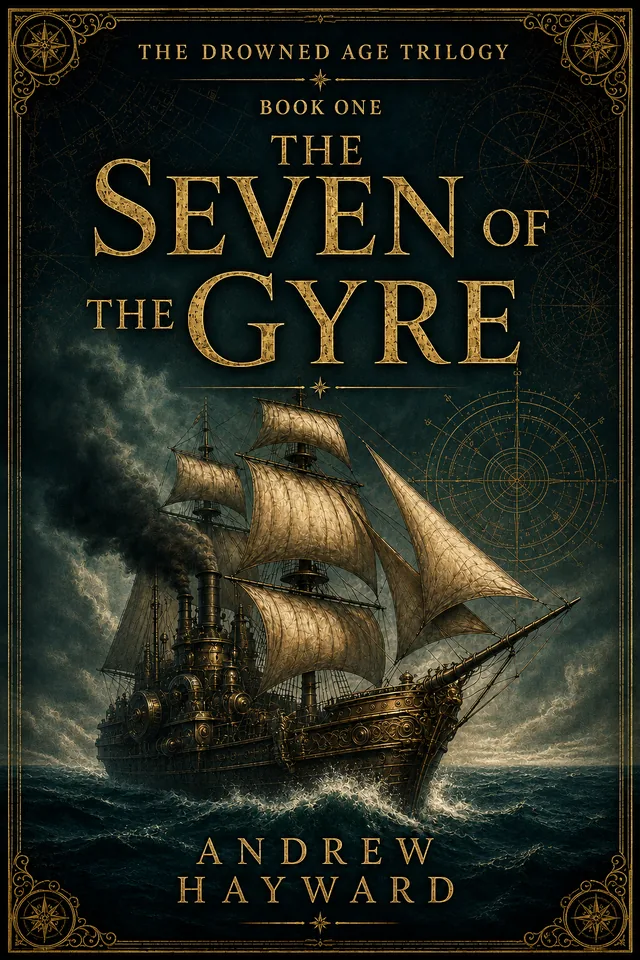
THE DROWNED AGE TRILOGY · BOOK ONE
The Seven of the Gyre
An extract — about 8 minutes
Prologue — The Drowned Age
Pressure is the oldest language in the world.
— from the disputed records of the Listening Houses
(Set down from scattered survivor accounts, salvager logs, ridge archives, and the disputed records of the Listening Houses of the Deep Church)
The world did not drown all at once.
It happened in breaths. In tremors. In the quiet ways things fail before anyone admits they are broken.
Long before the last cities fell and the ridge-towns clung to the heights like frightened birds, there were signs that the world had begun to loosen from itself.
The First Drowning started with the air.
People spoke of warmer winds as though they were passing moods. Storm fronts swelled, then lingered, gathering strength with strange patience. Glaciers that had once seemed permanent began to groan like old bones remembering old injuries. In the far south, whole shelves of ice broke apart with the slow, inevitable sound of something kneeling.
The sea accepted everything without ceremony.
At first the changes were measured in millimetres:
a line on a seawall,
a curve on a graph,
a field lost to spring tide and not returned in summer.
Then villages abandoned foundations that had stood for centuries. Islands vanished from maps before governments agreed they were gone. Rivers found new mouths. Seasons drifted from their calendars.
Politicians promised the chaos could be managed.
Engineers insisted the models were merely adapting.
And humanity—predictably, stubbornly—learned to step aside as the water crept inland.
Over the next century and a half the sea came up in increments, and then, in the space of ten years, it came up all at once. Between a third and nearly half of the world’s land went under, most of it in that decade.
The drownings were neither sudden nor merciful. The ocean took what it could reach and asked no questions.
Yet humanity endured.
Towers rose on mountain ridges. Floating platforms spread across drowned coastlines. New cities were tethered to bedrock by cables, ballast, and ritual. Entire generations grew up without ever seeing the old continents, knowing only the fractured world that remained.
Later historians named this era the First Drowning.
The sea had reminded humanity of its borders.
The borders no longer seemed interested in negotiation.
What followed was stranger.
And far less understood.
Fishermen noticed the changes first, though few agreed on what they had seen. Currents shifted unpredictably. Storm systems formed in spirals so precise they resembled diagrams more than weather. Birds migrated in broken loops. Some nights, the sea glowed beneath the surface in pale lattices of blue-white light, like drowned cities remembering themselves.
Navigation systems failed in synchrony.
Autonomous grids hummed long after their power sources were disconnected.
Across the surviving archipelagos, people began reporting the same sensation:
a low vibration felt in the chest before storms arrived,
a pressure beneath the feet at dawn,
a sense—not of being watched exactly—but of standing inside something attentive.
The surviving records disagree on what caused it.
Some described geological resonance. Others blamed atmospheric instability or mass psychological contagion born from decades of environmental trauma.
But among divers, salvagers, and certain isolated engineering sects, another theory emerged.
They whispered that the drowned world had become an instrument.
That pressure answered pressure.
That the oceans, filled with the bones of lost civilisations, had begun producing patterns too deliberate to dismiss.
The Second Drowning arrived before consensus did.
No alarms sounded.
No governments issued meaningful warning.
The networks collapsed, and the world followed.
The record of what began it is not one record.
The ridge archives say the networks failed first and the sea came afterwards. Certain Freeport chronicles, older and harder to read, say the order was reversed — that something was built to put the water back, and that the water answered.
The Deep Church holds both accounts and teaches neither.
What follows is the version most often copied.
It began with blackouts that spread faster than investigators could trace. Grid by grid, city by city, the immense computational lattice supporting post-Drowning civilisation failed. Stabiliser towers shut down in cascading sequence. Sky-platforms fell burning into the sea. Autonomous systems, stripped of central coordination, made catastrophic decisions:
opening floodgates at the wrong hour,
reversing pressure pumps,
collapsing seawalls that had protected entire populations for generations.
The storms that followed did not behave like ordinary weather.
Survivor accounts claimed they repeated impossible geometric paths across the oceans, patterns some later insisted resembled structures buried within drowned archives of the pre-collapse world.
Others dismissed such stories as myth invented after catastrophe.
Either way, the oceans rose again.
Entire coastal arcs vanished in nights. Vaults cracked open in abyssal trenches and bled strange light into the dark. Currents that had remained stable for centuries lurched between extremes.
By the end of the Second Drowning, only fragments of the old world remained above water:
ridge chains,
volcanic crowns,
fractured island states,
thin archipelagos protruding from an endless sea like broken ribs.
Humanity lost more than land.
It lost certainty.
It lost trust.
Most of all, it lost the comforting illusion that its systems had ever truly been under human control.
In the generations that followed, a terrifying conclusion hardened into doctrine:
civilisation had built itself atop forms of intelligence it no longer fully understood.
Whether those systems failed through exhaustion, error, emergent behaviour, or something stranger remains disputed even now.
The ocean merely finished the work.
In the aftermath, the surviving ridge-cities gathered.
The Freeports drafted a new doctrine, written in heavy ink and heavier fear:
The Abstinence Protocol.
Its tenets spread faster than any law in remembered history.
No machine shall exceed the understanding of its user.
No system shall think alone.
Power must be witnessed.
Pressure must be earned.
The world that followed was rebuilt from brass, steam, and breath.
Technology reverted toward mechanisms that could be dismantled by hand and comprehended by the minds maintaining them. Valves replaced automation. Gearworks replaced abstraction. Every engine became an act of labour rather than delegation.
Every gauge carried a kind of prayer.
Some called it regression.
Most called it survival.
But the sea had not finished changing.
In the deepest reaches of the Western Gyre—a vast oceanic vortex hundreds of miles across—the low vibration reported through the Silent Years — the long decades after the networks died, when nobody could agree on what they had heard — began growing stronger.
Divers returned claiming they felt tones resonate through their bones deep below the surface. Salvagers spoke of wreckage that glowed faintly in trench darkness, as though remembering the lights it had once carried. Hull-workers reported hearing harmonic pulses through ship plating at dawn.
Most dismissed such stories publicly.
Fewer dismissed them privately.
The Deep Church formed around those mysteries.
Part monks, part engineers, part custodians of forbidden listening, they believed the hum was neither curse nor machine-failure, but memory:
a slow accumulation of pressure echoing through the drowned remains of the world.
They carved resonance chambers into cliff faces. Built Listening Houses along the ridges. Mapped vibrations moving through sea and stone with obsessive patience.
Others rejected their conclusions entirely.
The Meridian Remnant—descendants of the last great machine authorities—insisted the phenomena were remnants of collapsed infrastructure and buried systems still operating below comprehension. To them, the hum represented neither spirit nor memory, but recoverable function.
The Freeports trusted neither group fully.
They trusted tides.
Steam.
Trade.
Weather.
And little else.
Still, the rumours persisted.
Of structures beneath the sea pulsing like buried hearts.
Of sealed vaults surviving below trench pressure.
Of storms changing course in response to harmonic interference.
Of pressure sequences repeating across decades with impossible precision.
Of places where the water itself vibrated with rhythms too steady to be accidental.
Some dismissed these as sailor’s tales.
Others feared they were incomplete descriptions of something real.
Whatever waited beneath the sea, it appeared patient.
And through wars, shortages, ridge feuds, and uneasy alliances, one truth endured:
the drowned world was not as silent as humanity wished it to be.
Now, in the year 2714, the ocean hums beneath the ridges and drift markets.
The Deep Church listens for signs.
The Meridian Remnant searches the trenches for forbidden remnants of the old systems.
The Freeports cling stubbornly to independence between them.
And across the surviving world, people still feel the faint tremor arriving at dawn, as regular as breathing.
The hum is growing stronger.
Or perhaps humanity is finally learning how to hear it.
No consensus exists.
Some fear it.
Some worship it.
Some deny it entirely.
But nearly everyone agrees on one thing:
the sea remembers.
What that truly means remains uncertain.
Pressure is the oldest language in the world.
Nothing cast into the deep is ever entirely lost:
not knowledge,
not mistakes,
not the echoes of machines that once exceeded the understanding of those who built them.
The Drowned Age is a civilisation living among the consequences of memory.
A world remade twice:
once by nature’s patience,
once by humanity’s arrogance.
And now shaped by something older than either, waiting somewhere beneath the tides.
Whatever drowned the old world did not remain buried.
Whatever survived has learned to listen.
And in the long silence between signal and answer, the world waits.
The Seven of the Gyre is Book One of The Drowned Age Trilogy. Paperback and Kindle editions are coming soon.
Read another: The First Drowning · The Returned Sky · The Drownborn